Sage Intacct Review 2026: Enterprise Financial Management for Growing UK Businesses
You've outgrown Xero and QuickBooks. Your month-end close takes a fortnight. Your CFO is drowning in spreadsheets. Here's why Sage Intacct might be the platform that finally gives your finance team room to breathe.
There's a painful stage in every growing business's life. You're past the scrappy startup phase, revenue is climbing, maybe you've added a second entity or expanded internationally — but your accounting software still thinks you're a sole trader with a shoebox of receipts.
That's precisely the gap Sage Intacct is built to fill. It's a cloud-native financial management platform designed for CFOs and finance teams in businesses turning over between £2 million and £500 million. Not a basic bookkeeping tool. Not a sprawling ERP that takes eighteen months to implement. Something in between — and, honestly, something rather good.
Let's dig into what makes it tick in 2026, what the latest release brings to the table, and whether it's worth the investment for your business.
What Exactly Is Sage Intacct?
Sage Intacct is a cloud-native financial management platform. That "cloud-native" bit matters — it wasn't bolted onto an old desktop product or retrofitted for the internet. It was built from the ground up to live in the cloud, which means automatic updates, no servers in a cupboard somewhere, and access from anywhere with a browser.
Originally an American product (it was called Intacct before Sage acquired it), it's been steadily building out its UK presence, with full support for HMRC compliance, IFRS standards, and British banking integrations. The 2026 Release 1, launched on 13 February 2026, made the Finance Intelligence Agent available in the United Kingdom — a significant milestone for UK users.
Quick snapshot: Sage Intacct targets finance teams in businesses with 1–1,000 employees and £2M–£500M revenue. It boasts a 95% customer renewal rate and 99.8% SLA-backed uptime. It's ranked #1 in customer satisfaction by G2 and has received the highest product score in Core Financials for the Lower Midsize Enterprises Use Case from Gartner for five consecutive years.
Who Is Sage Intacct Actually For?
Let's be blunt: Sage Intacct isn't for everyone, and that's by design. If you're a sole trader or a small business with straightforward books, you'd be far better off with Sage Accounting or even Sage 50.
Sage Intacct shines when you've hit certain complexity thresholds:
Multi-entity businesses — running multiple companies, subsidiaries, or locations and need consolidated reporting without the spreadsheet gymnastics
CFOs who need dimensional reporting — you want to slice financial data by department, project, location, fund, or any other dimension without creating thousands of GL accounts
Nonprofits and charities — fund accounting, grant tracking, and GAAP/FASB 958 compliance reports are built in, not bolted on
SaaS and subscription businesses — revenue recognition under ASC 606/IFRS 15 is automated
Professional services firms — project accounting, time and expense tracking, and resource management in one place
Financial services companies — complex consolidation, inter-entity transactions, and regulatory reporting
"The biggest sign you've outgrown your current software isn't that it crashes — it's that your finance team spends more time working around its limitations than actually doing finance."
Core Features: What You're Actually Getting
Right, let's get into the meat of it. Sage Intacct packs a serious feature set, and understanding what each piece does will help you work out whether it's genuinely a fit.
Dimensional General Ledger
This is arguably Sage Intacct's signature feature, and it's the one that makes finance professionals go a bit misty-eyed. Traditional accounting software forces you to create rigid chart-of-accounts structures — if you want to track expenses by department and location and project, you end up with an ungodly number of GL accounts.
Sage Intacct flips this on its head. You maintain a clean, simple chart of natural accounts, then "tag" every transaction with dimensional attributes — department, location, project, fund, customer, vendor, or any custom dimension you create. Need to see revenue by region, then drill into a specific project within that region? A few clicks, done.
Multi-Entity Consolidation
If you're running multiple companies or subsidiaries, this is where Sage Intacct earns its keep. You can manage an unlimited number of entities from a single login, with automated inter-entity transactions, eliminations, and consolidated financial statements. Multi-currency support handles exchange rates automatically, and you can report in any base currency.
Revenue Recognition (ASC 606/IFRS 15)
For SaaS, subscription, and services businesses, compliant revenue recognition isn't optional — it's the law. Sage Intacct automates the entire process under ASC 606 and IFRS 15 standards, handling contract modifications, variable consideration, and performance obligations without requiring your team to maintain parallel spreadsheets.
AI-Powered Insights and Sage Copilot
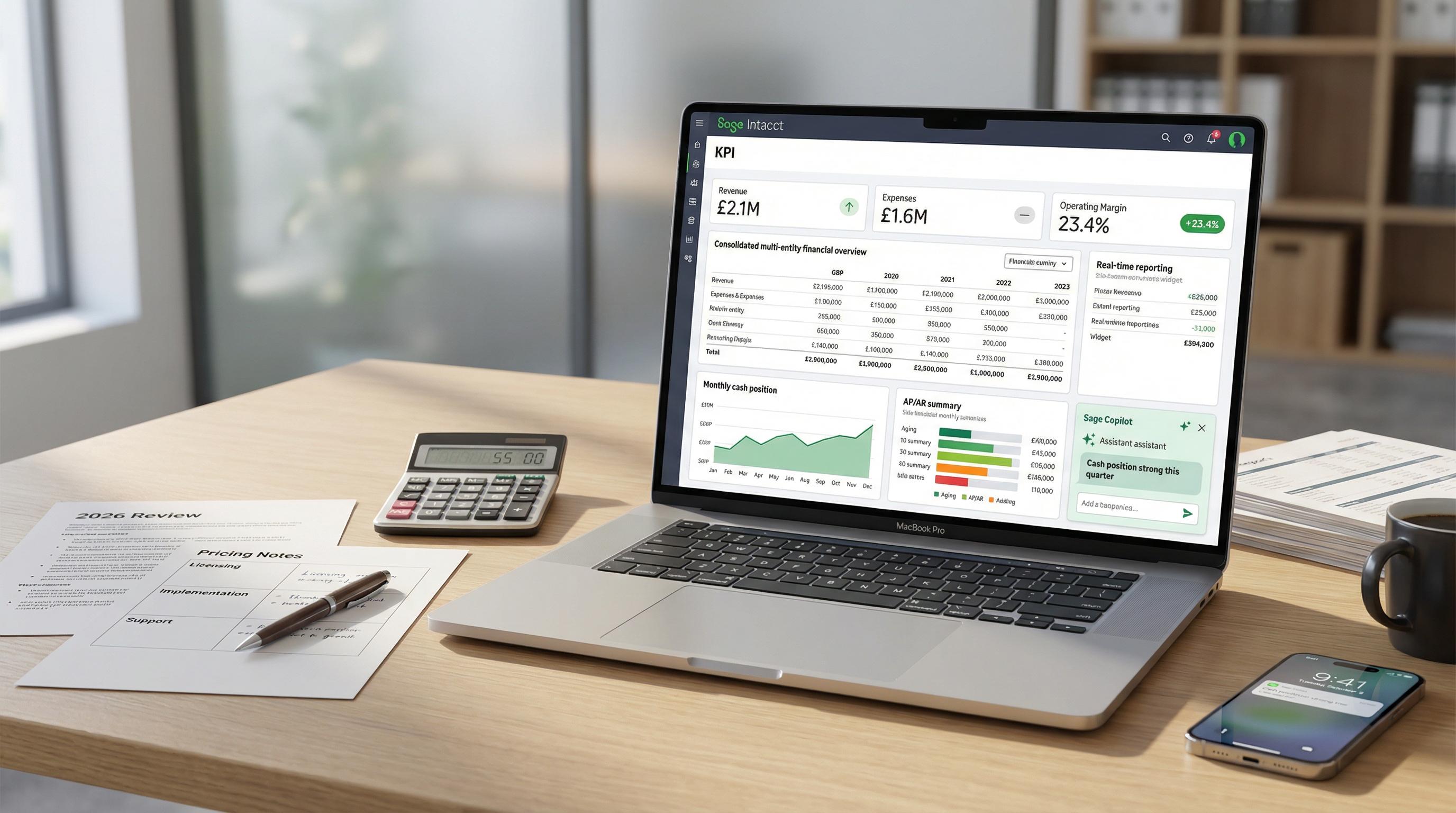
Sage Copilot is embedded directly into Intacct, and with the 2026 Release 1, it's become genuinely useful rather than a marketing gimmick. The new Finance Intelligence Agent lets you ask natural-language questions about your financial data — things like "What's our operating margin by department this quarter?" or "Show me the top ten overdue invoices by value" — and get instant answers without navigating menus or building reports.
AP/AR Automation
Accounts payable automation now includes line-level matching (more on this below in the 2026 updates section), tax prediction on automated bills, and smart routing workflows. On the receivables side, embedded customer payment services let your customers pay directly within invoices, and customer health insights track engagement and risk on every account record.
Project Accounting
Professional services firms will appreciate the integrated project accounting module, which connects time and expense tracking, budgeting, billing, and revenue recognition into a single workflow. The 2026 release added mass project updates and the ability to link projects directly to capital assets.

Nonprofit Toolkit
Sage Intacct's nonprofit capabilities aren't a bolt-on afterthought — they're a fully developed toolkit. Fund accounting, grant tracking and billing, restricted/unrestricted fund management, GAAP financial statements, FASB 958 compliance reports, and Form 990 worksheets are all built in. The dimensional GL is particularly powerful here, letting you track funds by programme, grant, location, or any other dimension.
Feature Area What It Does Best For Dimensional GL Tag transactions with unlimited dimensions; slice-and-dice reporting without bloating your chart of accounts All industries Multi-Entity Consolidation Manage unlimited entities, automated eliminations, consolidated financials, multi-currency Groups, holding companies, international businesses Revenue Recognition Automated ASC 606/IFRS 15 compliance, contract modifications, performance obligations SaaS, subscriptions, professional services AP/AR Automation Line-level matching, tax prediction, embedded payments, smart routing, customer health insights High-volume transaction businesses Project Accounting Time/expense tracking, project budgets, billing, resource management, CIP asset linking Professional services, construction Nonprofit Toolkit Fund accounting, grant tracking, FASB 958, Form 990, donor management integration Charities, nonprofits, religious organisations AI & Copilot Finance Intelligence Agent, natural-language queries, anomaly detection, close automation All industries Close Management Centralised task tracking, variance analysis, real-time monitoring, multi-base currency support Finance teams with complex close processes
2026 Release 1: What's New and Why It Matters
Sage Intacct follows a quarterly release schedule — four major updates a year, delivered automatically to all users. The 2026 Release 1, which landed on 13 February, is one of the meatiest in recent memory. Here are the highlights that UK businesses should care about.
Finance Intelligence Agent (AI Copilot)
This is the headline feature, and it's now available in the UK as an early adopter programme. Rather than navigating to different screens and building reports, you simply ask Sage Copilot a question in plain English. The Finance Intelligence Agent retrieves answers from your live financial data in real time.
It's not just a chatbot wrapper — it's pulling from your actual GL, AP, AR, and project data to deliver contextual insights. Think of it as having a data analyst on call, 24/7, who knows your books inside out.
AP Automation: Line-Level Matching
Previously, AP Automation matched at the document level. Now it predicts line entries based on vendor documents you email or upload, and flags individual lines that don't match. This is a substantial improvement for businesses processing hundreds of invoices a month — it catches discrepancies at the line level before they become problems.
AP Automation also now predicts tax details on automated bills when you're subscribed to the Taxes application. Less manual data entry, fewer errors.
GL Account Reconciliations
A brand-new feature for 2026: streamlined reconciliations that match offsetting debit and credit entry lines directly in the GL. If you've been doing this manually in spreadsheets, you'll understand why this is a big deal.
AI-Powered Import Agent
Data imports have always been a source of friction. The new AI-powered import agent lets you transform, map, and clean data using natural-language prompts, with instant previews before committing. It's a genuine time-saver for admins who regularly load transaction data from external sources.
Also new in 2026 R1: Close analytics (early adopter in UK) for identifying bottlenecks in your close process, embedded customer payment services through Fortis integration, work order management for service businesses, flexible retainage release for construction, and expanded cash requirements forecasting with multi-currency support.
Close Automation Upgrades
Close Automation now supports multi-base currencies — a critical update for international businesses. The close progress monitor has improved drill-down capabilities, letting you jump from status tiles straight to task lists. And Copilot-generated email templates for close workspace now incorporate your custom text, so automated communications actually sound like they came from your team.
Sage Intacct Versions and Pricing
Here's where things get a bit less straightforward. Sage Intacct doesn't publish a simple pricing page with monthly rates — it's a consultative sale, with pricing tailored to your modules, user count, and implementation needs.
That said, here's what you can expect based on current market data:
Version Starting Price Users & Add-Ons Best For Essentials From ~£20,000/year Up to 6 add-on modules, 1 additional user Businesses needing core cloud financials with room to grow Pro Custom pricing (higher tier) Up to 22 add-on modules, 2 additional users Multi-entity businesses needing advanced modules and reporting Custom Fully bespoke Unlimited modules and users, tailored implementation Large enterprises with complex, multi-country requirements
Budget realistically: The ~£20,000/year starting point covers the software subscription only. You'll also need to factor in implementation services (typically quoted in hours, not days), data migration, training, and ongoing support from a Sage partner. Total first-year costs for a mid-sized deployment can range from £30,000 to £80,000+. Also expect 3–7% annual price increases at renewal — multi-year contracts can help lock in rates.
Sage Intacct is sold exclusively on a subscription basis — typically annual with multi-year options. You won't find a monthly pay-as-you-go plan here. The good news is that you can add modules and users mid-term as your needs evolve.
There's no free trial available, which is one drawback. You'll need to go through a demo and consultative process with Sage or one of their accredited partners to get a quote tailored to your requirements.
Deployment, Security, and Compliance
As a cloud-native platform, there's nothing to install locally. Your team accesses Sage Intacct through a web browser, and updates are rolled out automatically each quarter — no IT department required for maintenance.
Uptime and Reliability
Sage offers an SLA-backed 99.8% uptime guarantee, with subscription credits if availability falls below that threshold (10% credit for each percentage point below 99.8%). In practice, Sage claims historical uptime of 99.998%, which translates to roughly ten minutes of downtime per year. You can check real-time status at their public status page.
Security and Compliance
This is where Sage Intacct takes things seriously:
SOC 1 and SOC 2 reports — available for download directly from your Intacct instance, covering controls over financial reporting, security, and availability
GDPR compliant — Sage maintains a record of processing activities under Article 30, with regular legal compliance audits
HIPAA certified — relevant for healthcare organisations handling patient data
PCI DSS Level 1 — the highest level of payment card security
Encryption — data encrypted both in transit and at rest
Audit trails — detailed logging of all access, modifications, and transactions, maintained for at least one year
For UK businesses worried about data sovereignty, Sage operates data centres that comply with applicable regional data protection requirements.
Industries Where Sage Intacct Excels
While Sage Intacct works across many sectors, it has particular depth in a handful of industries where the standard accounting model doesn't quite cut it.
Nonprofits and Charities
This is arguably Sage Intacct's strongest vertical. The combination of dimensional GL, fund accounting, grant tracking, and built-in compliance reporting (GAAP, FASB 958, Form 990) makes it one of the most comprehensive nonprofit accounting platforms available. Religious organisations benefit from the Ministry Intelligence module for congregation giving and membership analytics.
Professional Services
Project accounting, time and expense management, resource allocation, and revenue recognition under IFRS 15 create a complete financial picture for consultancies, law firms, and agencies. The 2026 release's mass project update feature is a genuine quality-of-life improvement for project managers.
SaaS and Technology
Subscription revenue recognition, multi-entity management for international operations, and robust API integrations make Intacct a natural fit for technology companies. The REST API receives continuous enhancements each release.
Financial Services
Complex consolidation requirements, regulatory reporting, inter-entity eliminations, and multi-currency support serve financial services firms that need precision and audit readiness.
Construction
The 2026 release added work order management, flexible retainage release, and construction-in-progress (CIP) asset management — making Intacct increasingly viable for construction and project-based businesses.
"Sage Intacct isn't trying to be everything to everyone. It's trying to be the best financial management platform for mid-market businesses that have genuinely complex needs — and that focus shows."
Pros and Cons: The Honest Assessment
No software is perfect, and a platform at this price point deserves a candid evaluation. Here's what genuinely impresses and what gives pause.
Pros Cons Dimensional GL eliminates chart-of-accounts bloat and transforms reporting flexibility Starting at ~£20,000/year puts it well beyond small business budgets True cloud-native architecture — no servers, no maintenance, automatic quarterly updates No free trial means committing to a demo process before you can evaluate hands-on Multi-entity consolidation is best-in-class for the mid-market Implementation costs can double or triple the first-year software spend 95% customer renewal rate speaks to genuine satisfaction Expect 3–7% annual price increases at renewal Deep nonprofit, SaaS, and professional services capabilities Less suited to manufacturing or retail without additional marketplace add-ons 2026 AI features (Finance Intelligence Agent, AI-powered imports) are genuinely useful Some 2026 R1 features are "early adopter" only — not generally available yet SOC 1/SOC 2, GDPR, HIPAA, PCI DSS Level 1 compliance Consultative sales process means no quick self-service sign-up Robust REST API and marketplace integrations UK-specific features still catching up to the US version in some areas
Tip for evaluators: Ask your Sage partner for a personalised demo using your own data (or a realistic mock-up). The dimensional GL and multi-entity consolidation are best understood when you see them working with numbers you recognise. Also request a detailed implementation timeline — the most common source of buyer frustration isn't the software itself, it's underestimating the setup.
How Does Sage Intacct Compare?
The most common comparisons are with Oracle NetSuite, Acumatica, and Microsoft Dynamics 365 Business Central. Without writing an entirely separate article on each (tempting), here's the short version:
vs. NetSuite: Sage Intacct is generally more affordable, faster to implement, and ranked higher in customer satisfaction (G2 ranks it #1 alternative to NetSuite). NetSuite offers broader ERP functionality beyond finance, which may matter if you need inventory, manufacturing, or e-commerce built in.
vs. Acumatica: Acumatica doesn't charge per-user fees, which can make it more cost-effective for larger teams. Sage Intacct tends to win on depth of financial reporting and nonprofit capabilities.
vs. Dynamics 365 Business Central: If you're deeply embedded in the Microsoft ecosystem, Business Central integrates more naturally with other Microsoft tools. Sage Intacct typically wins on ease of use and speed of deployment for pure financial management.
And for businesses currently on other Sage products like Sage 50 or Sage 200, Intacct represents a natural upgrade path within the Sage ecosystem — with the advantage of familiarity and existing partner relationships.
The Verdict: Is Sage Intacct Worth It in 2026?
Here's the thing: Sage Intacct isn't cheap, and it isn't trying to be. If your business turns over under £2 million and your finance needs are straightforward, the investment simply doesn't make sense. You'd be paying enterprise prices for capabilities you won't use.
But if you're a CFO or finance director who's spending more time wrestling with spreadsheets than analysing data? If your month-end close takes weeks instead of days? If you're managing multiple entities and your current software can't consolidate without manual intervention? Then yes, Sage Intacct is absolutely worth evaluating.
The 2026 Release 1 represents a genuine step forward — the Finance Intelligence Agent brings AI from buzzword to practical tool, line-level AP matching reduces manual work in a measurable way, and GL account reconciliations address one of the most tedious tasks in finance.
The 95% customer renewal rate isn't marketing fluff. Businesses that adopt Sage Intacct tend to stick with it, and that says more than any feature list ever could.
Bottom line: For UK businesses in the £2M–£500M revenue range — particularly in financial services, professional services, SaaS, and the nonprofit sector — Sage Intacct is one of the strongest cloud financial management platforms available in 2026. The investment is significant, but for the right organisation, the return in time saved, reporting quality, and financial control is substantial. Explore the Sage ecosystem to find the right fit for your business.
This article contains affiliate links. If you click through and make a purchase, we may earn a commission at no additional cost to you. All opinions and assessments are our own, based on independent research. Pricing information is accurate as of March 2026 and may vary based on your specific requirements and negotiation with Sage or their accredited partners. Sage Intacct is a registered trademark of The Sage Group plc.